


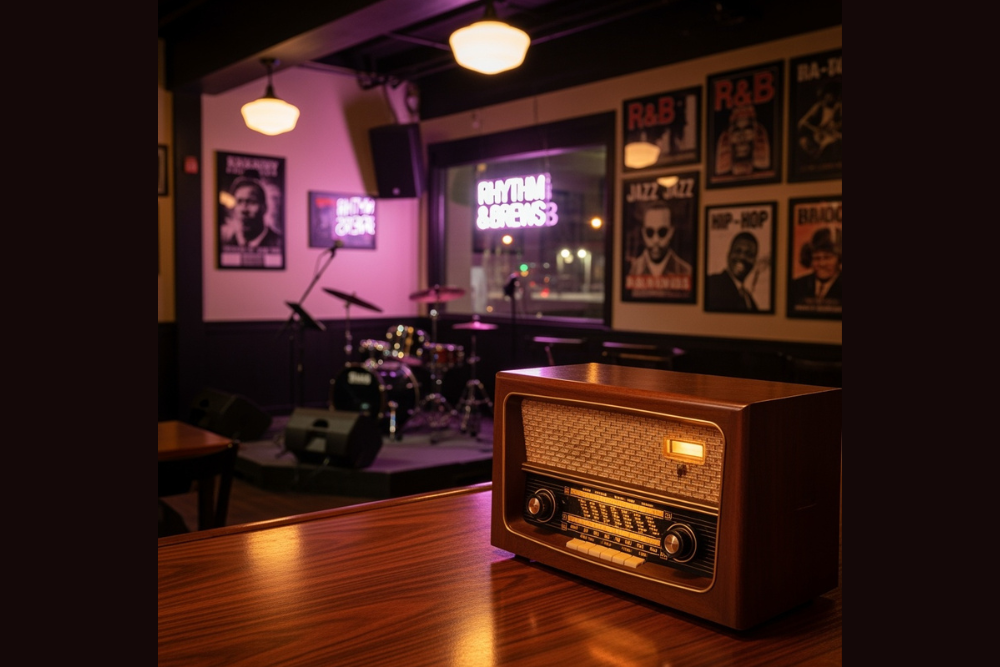
There is a conversation happening right now between two people somewhere — maybe over brunch, maybe in a car, maybe in a text thread — where nobody is speaking in plain sentences. One person says something, and the other one finishes it with a lyric. No explanation needed. No translation required. Just two people who grew up on the same music, communicating in the only language that has never let them down.
That is not a coincidence. That is culture doing exactly what it was built to do.
R&B Has Always Been a Second Language
Long before anyone called it a love language, music was functioning as one. The ability to drop a lyric mid-conversation and have someone finish it — or feel it — is not a party trick. It is a deeply embedded form of communication that carries more emotional weight than most words ever could.
A friend mentions feeling low, and without missing a beat the response is a nod to War’s 1971 classic. Someone talks about skipping brunch plans and frames the whole thing around a New Edition reference. A question gets half-answered and a Whitney Houston lyric fills the rest. These are not random moments. They are proof that the songs absorbed over a lifetime become part of how the brain processes and expresses emotion.
Music does not just accompany life. For a lot of people, it narrates it.
The Songs That Shaped the Way We Talk
Stevie Wonder. Marvin Gaye. Whitney Houston. Smokey Robinson. These are not just artists — they are emotional architects. The songs they made were not background music. They were instruction manuals for feelings that nobody had the vocabulary for yet.
Growing up surrounded by that catalog does something permanent to a person. The mother who told her kid that if they knew their schoolwork as well as they knew their song lyrics they would be a genius was not just joking. She was watching music do what formal education rarely does — make information feel personal enough to memorize without trying.
R&B in particular carries a specific kind of emotional precision. The lyrics are not vague. They are specific about heartbreak, joy, longing, and loyalty in ways that land differently depending on what stage of life you are in when you hear them. That specificity is exactly what makes them so usable in real conversation.
Why We Quote Songs Instead of Just Talking
There is a reason a well-placed lyric lands harder than a direct statement. Songs have already done the emotional heavy lifting. The melody, the delivery, the memory attached to the first time that song hit — all of it comes with the reference. When someone drops the right lyric in the right moment, they are not just communicating a thought. They are bringing an entire emotional history into the conversation.
That is something plain language almost never achieves on its own.
The phenomenon extends beyond personal conversations too. Public figures, journalists, and cultural commentators regularly reach for music references when making points that need to feel grounded and real. The reference works because it assumes a shared experience — and when that assumption lands, it creates an instant sense of belonging.
The Songwriters Who Made It All Possible
None of this happens without the people who actually wrote the songs. And the backstory of how those songs got made is often messier and more human than the finished product suggests.
Many of the most emotionally resonant hits in R&B and pop history were written under serious pressure — against deadlines, on the road, in the middle of personal chaos. The Motown hit factory was exactly that — a factory, with quotas and timelines and commercial demands running alongside genuine creative ambition. Paul McCartney and John Lennon wrote some of their most enduring work while exhausted and on tour.
The miracle is not that the songs were made under those conditions. The miracle is that they still feel like they came from somewhere true. Because they did. Pressure does not kill authenticity — sometimes it is exactly what forces it to the surface.
Music This Deep Does Not Stay in the Speakers
The legacy of R&B is not just a playlist. It is a communication system that has been running for decades — across generations, across conversations, across every moment where words alone were not quite enough.
The songs are still working. Every time someone finishes a sentence with a lyric instead of their own words, every time a reference lands and two people feel it at the same time — that is the music doing what it was always meant to do.
It never stopped playing. It just moved into the conversation.
