


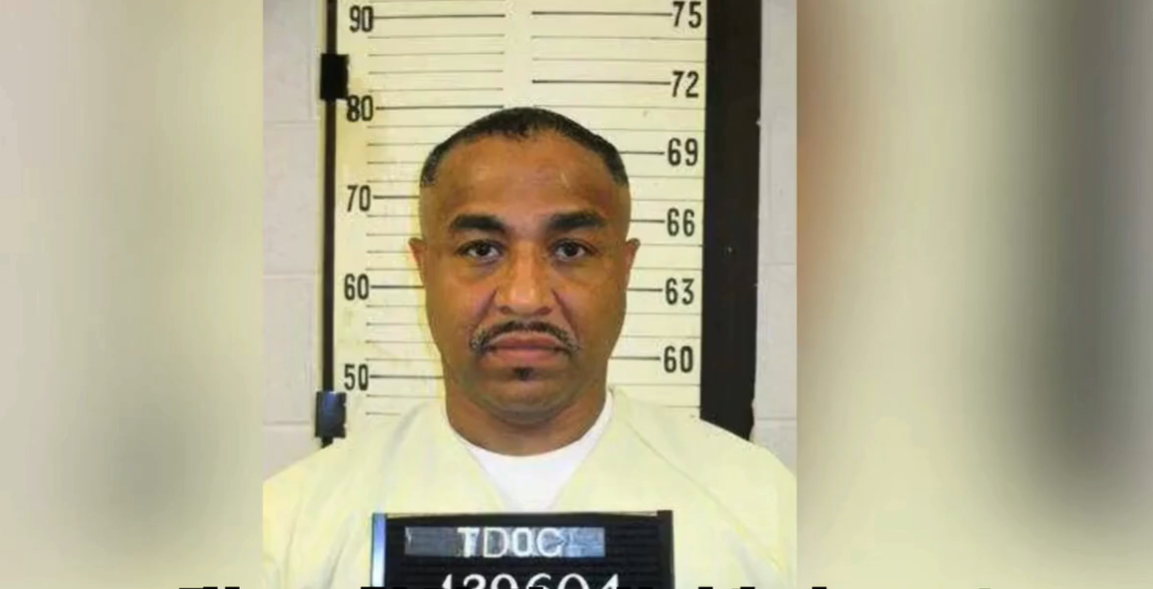
Thirty years after one of Memphis’s most disturbing murder cases sent two men to death row, the fight to determine whether the right person is being punished is reaching a critical breaking point. Tony Carruthers, convicted in connection with a 1994 triple murder, is facing an execution date next month and new legal filings suggest that the physical evidence may tell an entirely different story from the one presented at trial.
3 victims found buried in a Memphis graveyard
On March 3, 1994, the bodies of 1. Marcellos Cello Anderson, 2. his mother Delois Anderson, and 3. Frederick Tucker were discovered buried beneath an existing casket in a Memphis cemetery. The three had been missing for roughly a week after being abducted from Delois Anderson’s home. A blood stained cloth was buried alongside them, and fingerprints were collected from the scene.
Investigators were pointed toward the grave by Jonathan Montgomery, who implicated both his brother James Montgomery and Carruthers in the kidnapping and killings. Prosecutors argued that Carruthers and the Montgomery brothers abducted Marcellos Anderson with the intent to rob him. Jonathan Montgomery died by suicide in his cell before the trial began, leaving his brother and Carruthers to face the charges alone. Both were convicted in 1996 on three counts of first-degree premeditated murder and sentenced to death.
ACLU says DNA at the crime scene does not match Carruthers
The American Civil Liberties Union has now filed a motion with the Tennessee Supreme Court arguing that critical DNA recovered from the scene does not connect Carruthers to the crime in any way. The organization is seeking to have unmatched fingerprints and DNA samples retested against an alternate suspect who was named during James Montgomery’s retrial.
According to the motion, no physical evidence has ever directly tied Carruthers to the murders. The prosecution’s case rested heavily on testimony from jailhouse informants a type of witness frequently associated with wrongful convictions. Six fingerprints recovered from the crime scene excluded both Carruthers and Montgomery entirely, and those prints have never been matched to anyone.
How Carruthers ended up representing himself at trial
Carruthers’ path to conviction was complicated by a chaotic legal process. He cycled through six different attorneys before ultimately representing himself at trial, a decision that his current legal team describes as damaging to his defense. A state Supreme Court opinion from 2000 documented that his behavior toward his lawyers had been threatening and disruptive, and raised questions about his mental health at the time of his arrest. His self representation left critical evidence including the fingerprint data largely unaddressed before the jury.
James Montgomery’s situation eventually took a different legal turn. An appeals court determined that Montgomery had been denied a fair trial, in part because of the circumstances surrounding Carruthers’ self representation, and overturned his conviction.
1 unidentified DNA profile found on blanket buried with the victims
During Montgomery’s retrial, DNA testing was conducted on physical evidence recovered from the grave site. The results excluded both men. Most samples were too degraded or small to yield conclusions, but one notable exception emerged: a complete male DNA profile was recovered from a white blanket buried with the 3 victims. That profile has never been matched to anyone.
Montgomery, while serving his sentence, provided a sworn statement identifying Ronnie Eyeball Irving as the actual perpetrator behind the kidnappings and murders. Despite the fact that both Montgomery’s DNA and fingerprints are now on file, the unidentified evidence from the grave has never been compared against Irving’s profile.
Carruthers legal appeals face significant hurdles
The Tennessee Court of Criminal Appeals recently denied Carruthers appeal for fingerprint testing, ruling that there was not a reasonable probability the results would alter the outcome of his prosecution. Carruthers and his legal team are hoping that DNA testing can be completed before his execution date. If results emerge that undermine the basis for his death sentence, his attorneys intend to pursue a stay of execution.
DNA has freed 34 people from death row since 1993
The broader context of this case is impossible to ignore. Since 1993, DNA evidence has led to the exoneration of 34 people across 15 states who had been sentenced to death. Each of those cases carries a shared thread, physical evidence that the legal system had not fully examined before sending someone to the execution chamber.
For Carruthers, the question of whether justice was served three decades ago may come down to the results of tests that were never done and whether they can be completed in time.
