


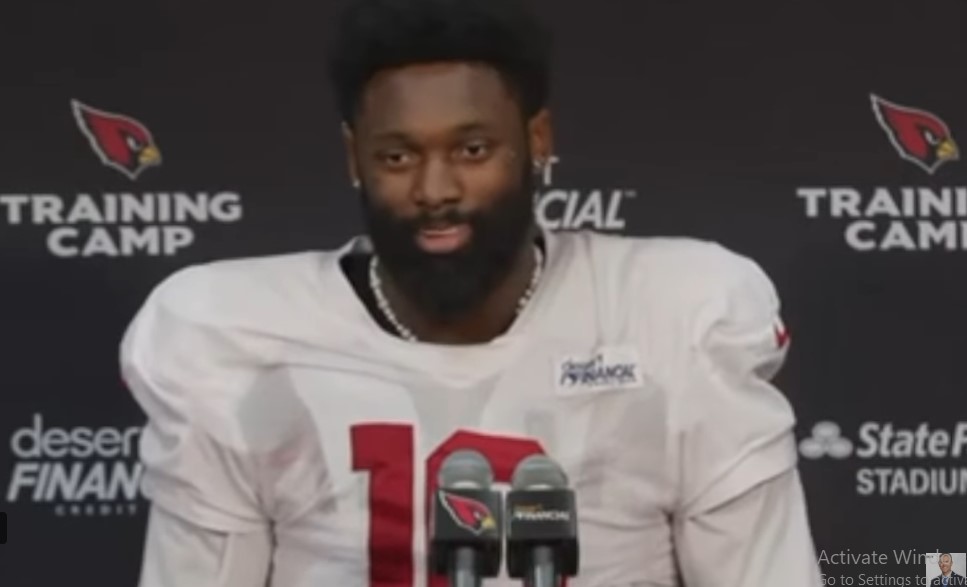

While other NFL teams dominated free agency headlines with splashy signings, the Arizona Cardinals watched from the sidelines. Their offseason additions amounted to left guard Isaac Seumalo, running back Tyler Allgeier and backup quarterback Gardner Minshew modest moves that left significant holes across the roster untouched.
Whether that restraint reflects disciplined long term thinking or dangerous passivity will likely be decided in April. With the No. 3 overall pick and six additional selections, the Cardinals are treating the 2026 NFL Draft as the primary engine of their rebuild. The needs are real and numerous: right tackle, defensive line, inside linebacker, edge rusher and interior offensive line depth all require attention that free agency did not provide.
And now there is an additional complication to navigate.
Josh Sweat’s trade request adds urgency
Josh Sweat had his best professional season in 2025, posting 12 sacks and 4 forced fumbles in his first year in Arizona under head coach Jonathan Gannon. When the Cardinals fired Gannon after the season, Sweat was reportedly displeased enough to request a trade.
The Green Bay Packers have emerged as one of the teams interested in acquiring him, which makes natural sense. Gannon is now Green Bay’s defensive coordinator, and he previously coached Sweat during two productive seasons with the Philadelphia Eagles, where Sweat recorded 7.5 and 11 sacks in back-to-back years. The Packers already re established a Gannon connection this week by signing defensive tackle Javon Hargrave who matched Sweat’s sack totals in those same two Philadelphia seasons to a two-year deal after his release from the Minnesota Vikings.
The timeline on any potential Sweat deal is pressing. His contract includes a $7.2 million option bonus due March 20, meaning the Cardinals will almost certainly need to act before that date if they intend to move him. Any acquiring team would absorb the bonus plus roughly $10 million in base salary and an additional $1.1 million in bonuses approximately $18.1 million in total 2026 compensation, with a restructured deal to lower the cap hit likely required.
If Sweat departs, Arizona’s edge rusher need escalates from moderate to urgent and would directly affect how the Cardinals approach their early draft picks.
The 7 round mock draft
Round 1, No. 3 overall, Francis Mauigoa, OT, Miami. Right tackle is Arizona’s most glaring positional weakness, and Mauigoa is the answer. He allowed just 3 sacks across his final two college seasons and brings the kind of high floor that rarely appears at this position in this range of the draft. Paired with Paris Johnson on the left side, Mauigoa would give the Cardinals two reliable bookend tackles for the foreseeable future. Utah’s Spencer Fano is a viable alternative, and a trade down for additional 2027 draft capital is worth considering if the board cooperates.
Round 2, No. 34 overall, Cashius Howell, Edge, Texas A&M. Alabama quarterback Ty Simpson is a name to watch here, but Arizona appears positioned to land a top three pick in 2027, where a true franchise quarterback should be in play. Howell is undersized but brings genuine explosiveness off the edge and would give Arizona a legitimate pass rushing complement to Sweat or a building block to replace him if the trade materializes.
Round 3, No. 65 overall, Josiah Trotter, LB, Missouri. Trotter is a physical, downhill run defender with sharp instincts against ball carriers. His coverage limitations are real, but at this slot, trading coverage range for an immediate upgrade over Cody Simon in run defense is a fair exchange. The Cardinals need someone who can anchor the linebacker group against the run, and Trotter fits.
Round 4, No. 104 overall, Rayshaun Benny, DT, Michigan. The Cardinals defensive interior behind Walter Nolen is composed largely of veteran role players without significant upside. Benny brings both intensity and run stopping ability that could develop into something meaningful, particularly in a rotational role early in his career.
Round 5, No. 141 overall, Caleb Douglas, WR, Texas Tech. Douglas ran a 4.39 second 40 yard dash at the combine and ranked 19th nationally with 14 deep catches last season. Arizona’s receiver room currently lacks a true deep threat capable of stretching defenses and creating space underneath. Even in a limited rotational role initially, Douglas addresses that gap and adds a dimension to the offense that the current group cannot provide.
Round 6, No. 182 overall, Cade Klubnik, QB, Clemson. A disappointing senior season has lowered Klubnik’s draft stock considerably, but the physical tools that made him a highly regarded prospect are still present. A late round investment in developmental quarterback talent makes sense for a team that is still identifying its long term answer at the position. North Dakota State’s Cole Payton, a dual threat option, is another name worth monitoring at this spot.
Round 7, No. 217 overall, Domani Jackson, CB, Alabama. Jackson arrived in college as one of the most recruited cornerback prospects in recent memory, but never translated that recruiting profile into consistent production at USC or Alabama. The athleticism that generated the hype remains intact, and a seventh round selection for a player of his physical profile is a risk worth taking with special teams contributions as the realistic floor and developmental upside as the ceiling.
The bigger picture
Seven picks cannot solve every problem on Arizona’s roster, and some of these needs particularly if Sweat is traded may require the Cardinals to revisit the board mid draft and adjust their approach. The front office has shown a willingness to be deliberate and patient this offseason, which is either a sign of organizational discipline or a gamble that April’s draft can do work that free agency typically handles.
The answer will become much clearer by the time the Cardinals are on the clock at No. 3
