


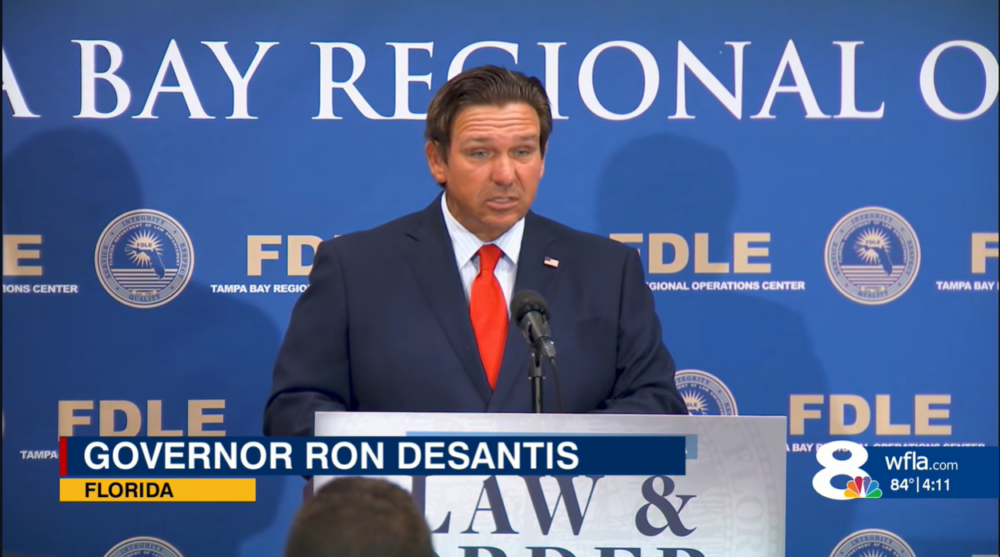
Florida Gov. Ron DeSantis has signed legislation requiring proof of citizenship for voters, a move that has immediately drawn criticism from civil rights groups, election officials and legal advocates who warn the law could push eligible voters off the rolls particularly in Black and Brown communities that have historically faced the highest barriers to political participation.
The law, which makes Florida the third state this year to adopt a version of the SAVE Act following South Dakota and Utah, requires election officials to verify citizenship status after a voter registers. That process involves cross-checking voter registrations against state and federal records. If a voter’s citizenship cannot be confirmed, officials are required to reach out and request documentation a REAL ID, birth certificate or passport. Voters who do not provide acceptable proof face removal from the voter rolls.
Who bears the burden
Civil rights attorneys have been quick to flag the uneven weight the law is likely to place on specific populations. The American Civil Liberties Union, which has already filed a lawsuit challenging the legislation, has highlighted older Black voters as one group particularly vulnerable to its requirements. Many elderly voters especially those born in Southern states during an era of segregated hospitals and inconsistent record keeping may have limited or no access to birth certificates, through no fault of their own.
That concern sits within a broader statistical reality. A study by the Brennan Center found that roughly 21 million U.S. citizens currently lack immediate access to documents that prove their citizenship. That figure alone raises pointed questions about the practical effect of a law that treats documentation as a baseline requirement for staying on the voter rolls.
Racial profiling concerns take center stage
Beyond the documentation issue, critics have raised the question of how election officials will decide which registrations require additional scrutiny. The absence of a clear, objective standard opens the door to decisions that could be shaped consciously or not by a voter’s name, background or perceived ethnicity. For communities already navigating a political climate marked by heightened immigration enforcement, that uncertainty is not abstract. It carries a lived weight that shapes how people approach government institutions, including the act of voting itself.
Election officials sound the alarm
On the administrative side, the law is already creating logistical headaches. Wendy Sartory Link, the Palm Beach County Supervisor of Elections, has noted that her office will need to build out new systems and processes to handle citizenship verification infrastructure that does not yet exist. That includes updating computer systems, working through questions about how different forms of documentation will be evaluated and potentially bringing on additional staff to absorb the workload. The timeline and cost of those changes remain unclear.
A familiar pattern with a troubling track record
History offers a cautionary reference point. Kansas passed its own proof-of-citizenship voting law in 2011, and the results were striking in the wrong direction thousands of eligible voters were blocked from registering because they could not produce the required paperwork. A federal judge struck the law down in 2018, but not before years of documented harm to voter participation in the state.
The stakes for democracy
Florida’s law arrives as voting rights remain one of the most contested issues in American political life. Advocates say that the pattern of proof-of-citizenship legislation framed consistently as a safeguard against fraud despite minimal evidence that noncitizen voting is a widespread problem functions in practice as a mechanism for narrowing the electorate. The voices most likely to be lost are those that already face the steepest climb to the ballot box.
With the ACLU‘s legal challenge now underway, the law’s future is uncertain. But its passage has already renewed urgency around a question that has defined American democracy for generations: who, in the end, gets to be counted.
