


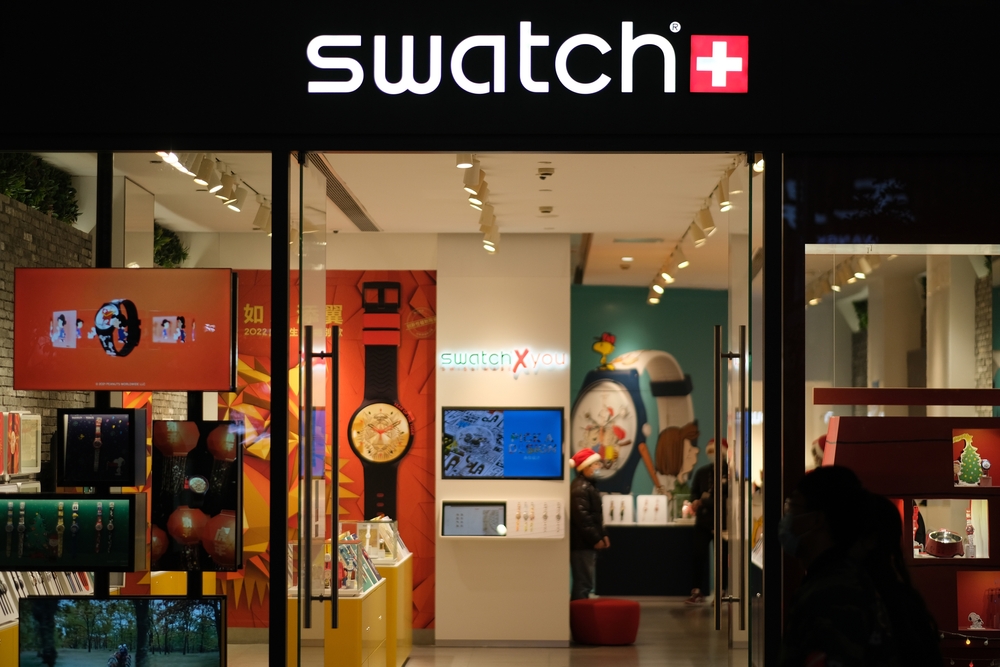
When Swatch and luxury Swiss watchmaker Audemars Piguet announced they were working together, the watch world started speculating immediately. Many assumed the result would be an affordable take on the Royal Oak, one of the most coveted wristwatches ever produced. What arrived instead was something entirely different: a rainbow-colored pocket watch.
The Royal Pop collection borrows the Royal Oak’s most iconic design details, including its octagonal bezel and textured dial, and rebuilds them in a pop-art spirit using Swatch’s Bioceramic material. The watches measure 40mm and come in two crown configurations, both powered by a manually wound movement with a sapphire caseback and a visible power reserve indicator. The crystal is scratch-resistant sapphire with an anti-reflective coating.
Eight color variants make up the collection, each with its own name, ranging from Huit Blanc in clean white and Ocho Negro in jet black to Otto Rosso in bold red and Otg Roz in coral pink. Retail prices run between $400 and $420, with sales limited to one watch per person per day at 200 Swatch boutiques worldwide. The watches were inspired by the pop art movement of the 1950s and 60s, and Swatch described the line as a combination of joyful boldness and fine watchmaking.
Stores shut down as crowds spiral
The gap between a $400 price point and an Audemars Piguet name proved to be an explosive combination. Long before the official launch date of May 16, crowds had already begun forming outside Swatch locations around the world, and what followed tested the limits of what retail environments are built to handle.
In Liverpool, some shoppers camped outside the Paradise Street store for two full days ahead of the release. Merseyside Police responded to reports of aggressive behavior and threats outside the shop early Saturday morning, though the crowd dispersed after officers arrived. Similar scenes played out in Birmingham, Cardiff, Glasgow, Manchester and Sheffield, and Swatch ultimately decided to keep all of those locations closed on launch day.
London stores did not open either. The company cited safety concerns for both customers and staff as the reason for the closures across the United Kingdom.
The situation was not limited to Britain. In Dubai, a large crowd gathered at the mall in the early hours of the morning and the scene became disorderly enough that the launch event was cancelled entirely. In Mumbai, the store chose not to open for the launch after mall management struggled to contain the crowd outside. At the Times Square location in New York, watch enthusiasts camped overnight to secure a place in line. In Tokyo, queues built up over multiple days outside the local branch. Some people waiting in line in New York reportedly became unwell during the extended wait.
The Royal Pop resale market moved before the watches did
For many people in those lines for the Royal Pop, wearing the watch was never the point. The resale market for the Royal Pop collection was already running well before the official launch date arrived. More than 100 watches had sold on StockX by the morning of May 15, a full day before the collection went on sale in stores. Individual watches that retail for $400 to $420 were averaging around $905 on the secondary market. The complete set of watches and lanyards sold for more than $8,000 on the platform. In the United Kingdom, some listings appeared online at prices as high as £16,000.
The most sought-after variants on the resale market were the Savonnette Lan Ba in pastel blue, the Huit Blanc in white and the Ocho Negro in black. Lanyards from the collection were averaging $245 separately.
At the Westfield Topanga mall in Los Angeles, more than 300 people gathered ahead of the release of Royal Pop before police limited the line to 200 due to supply constraints. Some who had waited for hours were turned away without a watch. One shopper who had lined up specifically to wear the Royal Pop rather than resell it noted that nearly everyone else around him had a different plan in mind.
A release that divided the watch world
Not everyone welcomed the Royal Pop with open arms. Within the collector community, the collaboration sparked a genuine debate about what it means for one of watchmaking’s most prestigious names to attach itself to a mass-market product at this price point. Some longtime Audemars Piguet collectors voiced frustration, arguing that the partnership undercuts both the exclusivity and the financial value of owning the full-price pieces. At least one prominent collector with a significant investment in AP timepieces threatened publicly to offload his collection if the Royal Pop proved too popular.
For the majority of people camping outside malls at 3 a.m., however, the Royal Pop represented something that does not come along often: an entry point into one of watchmaking’s most admired design languages without a waitlist, a dealer relationship or a six-figure budget. Whether that reads as a cultural moment or a brand miscalculation depends almost entirely on where you were standing when the doors finally opened, and whether you made it inside before they closed again.
