


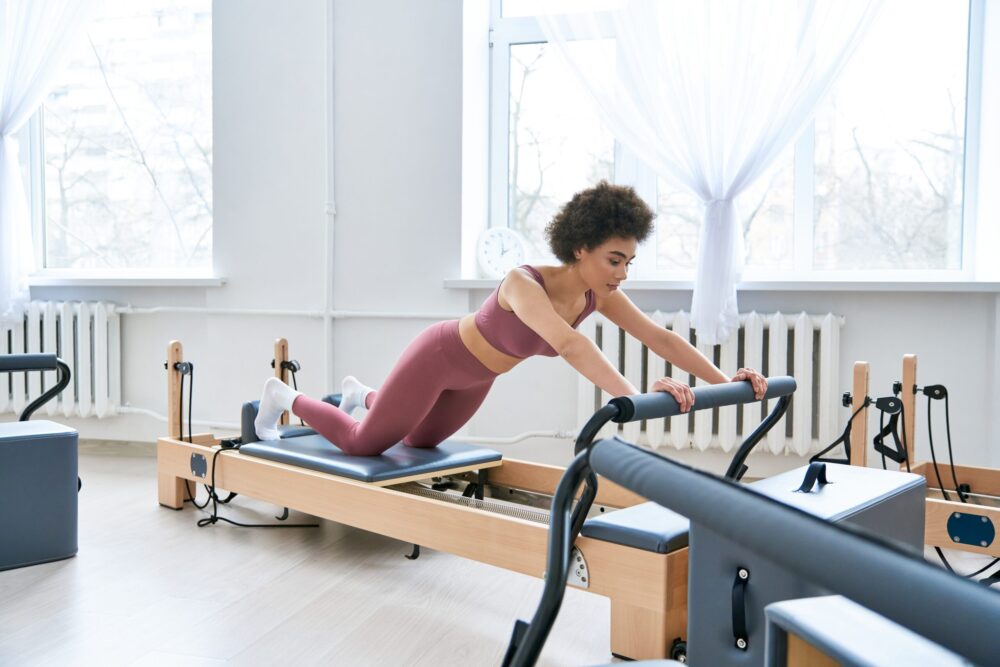
Black instructors reshaping Pilates for everyone, was never meant to be a personality type. Pilates was developed in the 1920s by German gymnast Joseph Pilates, the method was originally designed as a full body rehabilitation and strength system one built around breath, core control, and physical alignment. For decades, it served athletes, dancers, and anyone looking to rebuild or strengthen their bodies with intention.
Nearly a century later, the practice has exploded in mainstream popularity, particularly among women. Whether performed on a mat at home or on a reformer machine at a boutique studio, Pilates has attracted a devoted following who credit it with everything from reduced stress to improved posture. But with that popularity has come something its founder almost certainly never anticipated, a deeply complicated cultural conversation about who Pilates is really for and who gets to define it.
The rise of the Pilates girl and what it actually means
Social media did not invent the idea of the Pilates girl, but it absolutely amplified it. Across platforms, a particular image has taken hold: lean, disciplined, often white, and unmistakably affluent. The aesthetic has become its own subgenre of wellness content, complete with matching sets, green juices, and a curated sense of effortless health.
The image has also attracted a troubling new audience. Some men online have begun treating Pilates participation as a screening criterion for potential partners, framing the workout as a signal of femininity, domesticity, and lifestyle compatibility. One online entrepreneur went viral after declaring that a woman who does Pilates is automatically a relationship green flag a sentiment that spread quickly and drew significant backlash.
Critics were quick to point out the obvious problem, reducing women to their fitness routines is not a compliment. It reflects a broader pattern of attaching traditional gender expectations to wellness spaces, and Pilates instructors across the country have been vocal in pushing back.
The instructors fighting to reclaim the practice
For instructors of color, the trending conversation has felt like a reminder of a much older issue. Pilates has long had a representation problem. Studios are expensive a single 60 minute group class can cost between $30 and $65 and the faces most visible in its marketing have historically reflected a narrow slice of the population.
Sabrina Seymore, owner of the first Black owned Pilates studio in North Carolina, has spoken openly about the disconnect between what Pilates actually is a practice rooted in strength and body awareness and how it is increasingly being sold. She has described the current moment as a collision between aesthetic culture and outdated gender norms, one that misses the point of the work entirely.
In Brooklyn, Tay Milburn, owner of Fringe Pilates, has similarly emphasized that the practice is a tool for wellness and self discovery, not a means of achieving a particular look or signaling a particular lifestyle. Her studio reflects a growing movement among instructors who want to expand who feels welcome on the mat.
Sonja R. Price Herbert, founder of Black Girl Pilates, built her organization specifically in response to the lack of representation she witnessed firsthand. Her work focuses on creating safe, affirming spaces for Black women within a fitness community that has not always made them feel seen. The initiative has grown steadily, connecting practitioners across the country who are looking for something the mainstream Pilates world has often failed to offer.
What the future of Pilates could look like
The conversation happening around Pilates right now is uncomfortable, but it is also necessary. The practice itself is not the problem. Pilates, at its core, remains what it has always been an accessible, adaptable method for building strength and awareness in the body. The problem lies in the cultural machinery that has wrapped around it, narrowing its image and attaching it to ideals that serve neither the practice nor the people who could benefit most from it.
The instructors and practitioners working to diversify and reclaim Pilates are not asking for something radical. They are asking for the practice to be returned to its original premise, that building strength in the body is for everyone. As more diverse voices continue shaping what Pilates looks like and who it speaks to, the hope is that the workout’s cultural moment becomes an opening rather than a wall one that invites more people in rather than quietly turning them away.
